


Friday, March 20, 2026
- Advertisment -
Google search engine
Home Blog Page 15

Kuwaiti-born Jordanian Medical Doctor Yousif Abdulraouf Alhallaq Charged With U.S. Naturalisation Fraud

0

A federal grand jury has returned an indictment charging a former medical doctor with naturalisation fraud, for providing false answers on a U.S. citizenship application and during an in-person interview.

According to the factual allegations in the indictment, Yousif Abdulraouf Alhallaq, 46, of Canton, was born in Kuwait but was a Jordanian citizen at the time he entered the United States on an H1B visa in 2006.

In 2011, Alhallaq filed an application to become a permanent resident of the United States, which was approved and granted him lawful status. Since approximately 2012, Alhallaq has worked as a medical doctor in Northeast Ohio. \

Then, in December 2014, the defendant poisoned a victim who was pregnant with his child, in an attempt to terminate the pregnancy without her knowledge.

On March 18, 2021, Alhallaq was indicted in the Stark County Court of Common Pleas and charged with one count of attempted murder and two counts of felonious assault for trying to purposely cause the termination of the victim’s pregnancy and knowingly causing serious physical harm to the victim and her unborn child.

In September 2021, Alhallaq pleaded guilty to the charges and was sentenced to four years in prison.

Before Alhallaq was indicted and sentenced in 2021, Alhallaq mailed a federal application, Form N-400, in late 2017 to become a naturalised U.S. citizen. In the application, he submitted “no” answers to the following questions:

  • 14C – Were you ever involved in any way with killing or trying to kill someone?
  • 14D – Were you ever involved in any way with badly hurting, or trying to hurt a person on purpose?
  • 22 – Have you ever committed, assisted in committing, or attempted to commit a crime or offense for which you were not arrested?

In March 2018, Alhallaq continued with the process of applying for U.S. citizenship and was interviewed by an immigration officer to review the previously submitted naturalisation application. Under oath, the defendant verbally confirmed answers to questions 14C, 14D, and 22 as “no”, which matched those initially submitted by mail.

On May 4, 2018, the defendant became a naturalised U.S. citizen during a ceremony in Stark County, Ohio.

The grand jury charges that although Alhallaq knowingly committed acts of attempted murder and felonious assault against his unborn child in 2014, he nonetheless proceeded to sign his naturalisation application in 2017 and then provided verbal confirmation to an immigration official during an interview in 2018 and in both instances attested to the truthfulness of the information he provided, which resulted in being granted U.S. citizenship.

Alhallaq faces a maximum of up to 10 years in prison for naturalisation fraud.

If convicted, the defendant’s sentence will be determined by the Court after a review of factors unique to this case, including the defendant’s prior criminal record, his role in the offence, and the characteristics of the violation.

In all cases, the sentence will not exceed the statutory maximum, and in most cases, it will be less than the maximum.


Justice Department Begins Investigation of University of California System for Race, Sex-based Employment Practices

0

The Justice Department’s Civil Rights Division has opened an investigation into the University of California system, including its individual campuses, concerning potential race- and sex-based discrimination in university employment practices.

The University of California’s ‘UC 2030 Capacity Plan’ directs its campuses to hire “diverse” faculty members to meet race- and sex-based employment quotas.

These initiatives openly measure new hires by their race and sex, which potentially runs afoul of federal law.

The Civil Rights Division’s Employment Litigation Section will investigate whether the University of California is engaged in a pattern or practice of discrimination based on race, sex, and other protected characteristics, pursuant to Title VII of the Civil Rights Act of 1964.

“Public employers are bound by federal laws that prohibit racial and other employment discrimination,” said Assistant Attorney General Harmeet K. Dhillon of the Justice Department’s Civil Rights Division. “Institutional directives that use race- and sex-based hiring practices expose employers to legal risk under federal law.”

Eureka Chiropractor Carrie Musselman Jailed 20 Months, to Repay $2.3m for Defrauding Medicare

0

Carrie Musselman, 48, of Eureka, Illinois, was sentenced on June 24, 2025, to 20 months in prison and ordered to pay more than $2.3 million in restitution following her convictions on multiple charges related to her scheme to defraud Medicare and twelve other insurance companies.

A jury found Musselman guilty of one count of healthcare fraud and five counts of wire fraud after a 13-day trial in February 2025.

At the sentencing hearing before Senior U.S. District Judge Michael M. Mihm, the government presented evidence that Musselman, a chiropractor in Eureka, engaged in a multi-year fraud to steal more than $2.5 million from Medicare and other insurance companies.

As part of the scheme, Musselman submitted fraudulent insurance claims which indicated that services had been performed by medical doctors when they were actually performed by mid-level providers.

That resulted in automatic pay increases for Musselman to which she was not entitled.

Musselman also made claims that falsely asserted patients had received services that were never provided. These claims included purportedly providing patients with allergy injections when no such injections were given.

Instead, patients were sent home with oral drops that had not been approved by the Food and Drug Administration, were considered “experimental,” and had not been proven to be effective.

Musselman misrepresented services that were provided, again resulting in her receipt of payments to which she was not entitled. One of Musselman’s most highly reimbursed services, the placement of an electroacupuncture device, which she falsely billed as a surgically implanted neurostimulator, would not have qualified for any payment but for her deception.

Also at the hearing, Judge Mihm found that Musselman had committed perjury in her testimony. In doing so, the judge noted that Musselman’s statements lacked credibility. He stated that Musselman was well aware of the fraud she was committing and that she had directed and encouraged the fraud.

“This case should serve as a warning to anyone who would commit fraud against health insurance,” said Acting United States Attorney Gregory M. Gilmore. “We will seek out fraud, waste, and abuse and prosecute those who engage in it. Providers who take advantage of the trust placed in them to line their own pockets abandon their ethical responsibilities and raise health insurance costs for vulnerable patients.”

“The submission of false claims undermines the integrity of our federal healthcare system,” said Linda T. Hanley, Special Agent in Charge with the United States Department of Health and Human Services Office of Inspector General. “We remain committed to holding healthcare providers accountable for complying with Medicare regulations so that enrollees can continue to rely on the program and receive the care they deserve.”

“Bad actors in healthcare, such as Dr. Musselman, think they can cover up fraud through clouded paperwork and technical healthcare jargon all while they commit illegal acts such as false claims, fraudulent services, and in this case, services not even rendered,” said Christopher J.S. Johnson, the Special Agent in Charge of the FBI Springfield Field Office. “This sentencing and ordered restitution are a testament to the FBI’s commitment to working these types of cases. It doesn’t matter how clouded the paperwork, or how many files there are to go through, if there is a victim, then there will be an agent investigating it.”

Wakpala Woman Malania Rose Fast Horse Jailed 13 Years for Killing Her Mother

0

United States Attorney Alison J. Ramsdell announced Friday that U.S. District Judge Charles B. Kornmann has sentenced a Wakpala, South Dakota, woman convicted of voluntary manslaughter.

The sentencing took place on June 23, 2025.

Malania Rose Fast Horse, 25, was sentenced to 13 years in federal prison, followed by three years of supervised release, and ordered to pay a $100 special assessment to the Federal Crime Victims Fund.

Fast Horse was indicted by a federal grand jury in January 2025. She pleaded guilty on March 6, 2025.

Fast Horse quarrelled with her mother in their Wakpala, South Dakota, home, within the Standing Rock Sioux Indian Reservation, on Christmas Eve 2024. Fast Horse lost her temper and stabbed her mother several times in the chest, arm, and hand.

Fast Horse ambled to her grandmother’s home next door and told her grandmother and brother she had stabbed her mother. She then grabbed some cigarettes and left. Fast Horse’s brother ran next door, finding his mother lying in a pool of blood on the floor, alive but incoherent.

Although EMS was promptly dispatched, Fast Horse’s mother later succumbed to her injuries.

The U.S. Attorney’s Office prosecuted this matter because the Major Crimes Act, a federal statute, mandates that certain violent crimes alleged to have occurred in Indian country be prosecuted in federal court, rather than state court.

Fast Horse was immediately remanded to the custody of the U.S. Marshals Service.

U.S. Convicts Nec Bullion CEO Charles Uchenna Nwadavid of Multimillion-dollar Scam, Money Laundering

0

A Nigerian national pleaded guilty Wednesday in federal court in Boston to his involvement in the theft of more than $2.5 million from six romance scam victims by transferring their money to cryptocurrency accounts that he controlled.

Charles Uchenna Nwadavid, 35, of Abuja, Nigeria, pleaded guilty to mail fraud, aiding and abetting money laundering and money laundering. U.S. District Court Judge Leo T. Sorokin scheduled sentencing for Sept. 23, 2025.

Nwadavid was arrested in April 2025 upon arrival at Dallas-Fort Worth International Airport after a flight from the United Kingdom. In January 2024, a federal grand jury in Boston indicted Nwadavid on charges of mail fraud and money laundering.

According to the charging documents, “romance scams” recruit victims through advertisements for online relationships on dating or social media websites. Individuals perpetuating romance scams create fictitious profiles and then use them to gain victims’ trust through a purported romantic relationship.

Perpetrators then direct their victims to send money or to conduct financial transactions involving other victims’ money under false pretences, such as an urgent need for money to secure a multimillion-dollar inheritance or to pay for an unexpected hospitalisation.

Between approximately 2016 and September 2019, Nwadavid participated in romance scams that tricked victims into sending money abroad. In an effort to conceal the ultimate recipient of the victims’ funds, a victim from Massachusetts was tricked into receiving funds from five other victims around the United States.

The victim then passed the funds to Nwadavid through a series of cryptocurrency transactions. Nwadavid repeatedly accessed accounts in the victim’s name from overseas to transfer the victims’ funds to accounts he controlled at LocalBitcoins, an online cryptocurrency platform.

The mail fraud charge provides for a sentence of up to 20 years in prison, followed by three years of supervised release, a fine of up to $250,000 or twice the loss to the victim, restitution, and forfeiture.

The money laundering charges provide for a sentence of up to 20 years in prison, three years of supervised release, a fine of up to $500,000 or twice the value of the property involved in the laundering transactions, restitution, and forfeiture.

The defendant is subject to deportation upon completion of any sentence imposed. Sentences are imposed by a federal district court judge based upon the U.S. Sentencing Guidelines and statutes which govern the determination of a sentence in a criminal case.

Ecuador Captures Notorious Los Choneros Drug Kingpin José Adolfo Macías Villamar ‘Fito’ in Dramatic Raid

0

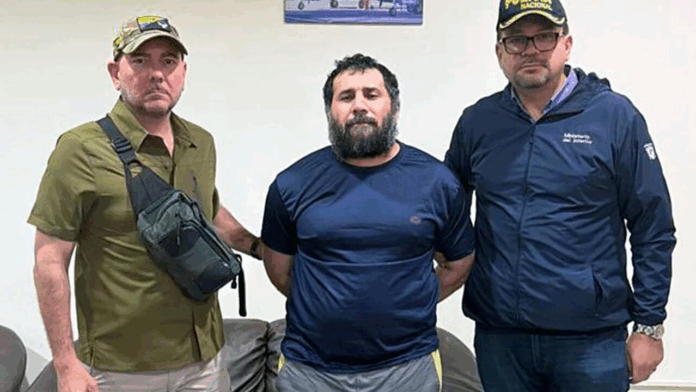
Ecuador’s year-long manhunt for its most wanted criminal ended dramatically this week with the capture of José Adolfo Macías Villamar, alias ‘Fito’, the notorious leader of the Los Choneros gang.

Fito, whose escape from prison in early 2024 plunged the country into chaos, was apprehended in his coastal hometown of Manta following a tense 10-hour operation involving both military and police forces.

The raid, which unfolded late Tuesday and into Wednesday, was hailed by President Daniel Noboa as a major victory in Ecuador’s ongoing battle against organised crime.

“The security block, armed forces and national police — after an operation of 10 hours, we achieved the capture of Jose Adolfo Macias Villamar, alias Fito. A successful operation of the security block,” Interior Minister John Reimberg announced.

Military footage released to the public showed the moment Fito was discovered hiding in a cramped space beneath a kitchen counter, an armed officer confirming his identity at gunpoint.

Fito’s capture marks the end of a 17-month saga that exposed the vulnerabilities of Ecuador’s prison and security systems. In January 2024, Fito vanished from Guayaquil Regional Prison, where he was serving a 34-year sentence for murder and drug trafficking.

His disappearance was only discovered when soldiers arrived to transfer him to a higher-security facility, finding his cell empty. The escape triggered an unprecedented wave of violence: riots erupted in seven prisons, explosions and attacks rocked cities, and armed men stormed a live television broadcast.

In response, President Daniel Noboa declared an internal armed conflict, militarised the streets, and labelled Los Choneros and 21 other criminal organisations as terrorist entities.

The United States Department of the Treasury imposed sanctions on both Fito and his gang for their roles in international drug trafficking and violent crime.

Fito’s criminal reach extended far beyond Ecuador’s borders; a U.S. indictment accuses him of smuggling tons of cocaine into the United States in collaboration with Mexican cartels, as well as orchestrating arms trafficking and assassinations.

Despite his imprisonment, Fito maintained control over Los Choneros, orchestrating criminal operations from behind bars and even releasing videos flanked by armed associates. His influence was so pervasive that the government recently offered a $1 million reward for information leading to his capture.

The operation to recapture Fito comes amid heightened scrutiny of Ecuador’s security forces, especially after the recent escape of another gang leader, Federico Gómez, alias “Fede”. Authorities say Fito will now face extradition proceedings to the United States, where he is wanted on multiple charges related to drug and weapons trafficking.

President Noboa and his administration have celebrated Fito’s arrest as a turning point in their campaign to reclaim the country from organised crime.

Fraudster Rodrick Florence Jr Jailed 72 Months for Bank Fraud, Stolen Identity Scheme

0

Rodrick Florence Jr., 35, of Atlanta, Georgia, was sentenced in federal court to 72 months in prison after having previously pled guilty to bank fraud conspiracy and aggravated identity theft charges. The sentence was announced by John P. Heekin, United States Attorney for the Northern District of Florida.

Court documents reflect that between 2021 and 2023, Florence possessed the personal identifying information of over 7,500 individuals for the purpose of fraudulently obtaining money from their bank accounts.

Florence worked with others to create fake identification and bank cards bearing real people’s information, which he and his conspirators used to access their account funds, including by making cash withdrawals and cashing counterfeit checks at various banks and credit unions through northwest Florida and across the nation.

From Navy Federal Credit Union alone, Florence and his accomplices attempted to access the accounts of over 250 of its members and successfully obtained over $335,000 using those stolen identities.

Florence was sentenced to 48 months for the bank fraud conspiracy count to be followed by a mandatory consecutive 24 months for the aggravated identity theft count, for a total prison sentence of 72 months.

Other members of the conspiracy were previously convicted in state court as part of this joint investigation. Freedom Prince Brown, 32, was sentenced to 48 months’ imprisonment after pleading to racketeering.

Ridel Baptiste Michel, 33, was sentenced to time served (approximately 20.5 months’ imprisonment) after pleading to racketeering.

James Matthew Spears, 60, was sentenced to time served (approximately 23.9 months’ imprisonment) after pleading to illegal use of personal identification information, grand theft, and possession of a forged driver’s licence.

Michelle Moore, 43, was sentenced to 24 months’ imprisonment after pleading to illegal use of personal identification information, grand theft, uttering forged bills or promissory notes, and possession of a forged driver’s licence.

“Navy Federal commends the efforts to hold accountable those who defrauded our members,” said a Navy Federal Spokesperson. “We fully support the pursuit of justice of the fullest extent permitted by the law.”

Carrollton Police Department Chief of Police Joel Richards said the sentencing of Florence Jr. “sends a clear message that criminal behavior of this nature will not be tolerated”.

Venezuelan National Gabriel Hurtado-Cariaco Suspected TdA Member Charged With Attempted Murder of U.S. Officer

0

Gabriel Hurtado-Cariaco, 30, a citizen of Venezuela residing illegally in Bellevue, Nebraska, was charged on June 19, 2025, by criminal complaint with one count of attempted murder of a federal officer and one count of assault of a federal officer with infliction of bodily injury.

Special agents with Homeland Security Investigations and the Federal Bureau of Investigation possessed an active immigration-related warrant for Hurtado-Cariaco’s arrest and encountered him in Sarpy County near his residence while he was driving. The agents initiated a traffic stop with lights and sirens.

Hurtado-Cariaco pulled over and exited his vehicle with his arms raised. The agents gave instructive commands to Hurtado-Cariaco and attempted to place him in handcuffs.

According to the complaint, Hurtado-Cariaco, a suspected member of Tren de Aragua, began to fight with a special agent, and both landed on the ground. Hurtado-Cariaco was able to throw the agent off him, launching the agent through the air, resulting in the agent forcefully striking their head and elbow on the pavement, injuring them.

A second special agent engaged with Hurtado-Cariaco to subdue and detain him.

Hurtado-Cariaco resisted, with both landing on the ground. While both agents tried to control Hurtado-Cariaco while on the ground, he manoeuvred behind the injured agent and placed that agent in a chokehold.

Hurtado-Cariaco ignored commands from the other agent and continued to choke the agent on the ground. The second agent placed Hurtado-Cariaco in a chokehold to stop the assault.

Hurtado-Cariaco released his chokehold on the agent and then used his leverage to break away from the second agent and ran. The agents pursued Hurtado-Cariaco on foot, locating him at his apartment in Bellevue and arresting him without further incident.

After the arrest, the injured agent was transported to the hospital for treatment.

“Deadly violence against law enforcement officers will not be tolerated by this Department of Justice,” said Attorney General Pamela Bondi. “We have charged this illegal alien with attempted murder.”

“The arrest and prosecution of this vicious Tren de Aragua gang member underscores our unwavering commitment to protecting our law enforcement officers in the line of duty,” said Deputy Attorney General Todd Blanche. “Violent attacks from terrorists against those who serve our communities will be met with swift and decisive justice.”

“Violence against federal law enforcement officers in the line of duty will not be tolerated in Nebraska,” said U.S. Attorney Lesley A. Woods.

Hurtado-Cariaco appeared before United States Magistrate Judge Ryan C. Carson on June 20, 2025. Magistrate Judge Carson ordered the defendant detained and set a preliminary and detention hearing for June 24, 2025.

A criminal complaint is a charging document that contains one or more individual counts that are merely accusations. Every defendant is presumed innocent unless and until proven guilty.

The maximum possible penalty if convicted is not more than 20 years in prison, a $250,000 fine, and a term of supervised release of up to three years.  Hurtado-Cariaco was arrested on June 18, 2025, in Sarpy County, Nebraska.

TD Bank Insider Jhonnatan Steven Rodriguez Convicted of Accepting Bribes to Fraudulently Open Over 100 Bank Accounts; Faces 60 Years Imprisonment, $2m Fine

0

A former Florida-based employee of TD Bank, N.A., pleaded guilty to accepting bribes in exchange for fraudulently opening more than 100 bank accounts, U.S. Attorney Alina Habba announced.

Jhonnatan Steven Rodriguez, aka Jorge, 32, of Naples, Florida, pleaded guilty before U.S. District Judge Esther Salas in Newark federal court to a two-count information charging him with one count of receipt of bribes by a bank employee and one count of making false bank entries.

Rodriguez’s sentencing is scheduled for November 25, 2025.

According to documents filed in these cases and statements made in court, in late 2022, Rodriguez began opening bank accounts for unknown individuals in exchange for bribes of approximately $200 to $250 per account.

During the scheme, Rodriguez accepted bribes in exchange for fraudulently opening approximately 140 bank accounts, some of which were used for fraud.

In carrying out this bribery scheme, Rodriguez would often forge the purported customers’ signatures on account opening documents. To protect his identity, Rodriguez used the alias “Jorge” on a text messaging app to communicate with the individuals seeking bank accounts.

The charge of receipt of bribes by a bank employee carries a maximum penalty of 30 years in prison and a fine of the greater of up to $1 million or three times the value of the thing given, offered, promised, solicited, demanded, accepted, or agreed to be accepted.

The charge of making false bank entries carries a maximum penalty of 30 years in prison and a fine of up to $1 million.

International Arms Dealer Kyrgyz national Sergei Zharnovnikov Convicted of Conspiring to Export Firearms to Russia

0

Earlier Wednesday in federal court in Brooklyn, Kyrgyz national Sergei Zharnovnikov pleaded guilty to conspiracy to commit export violations.

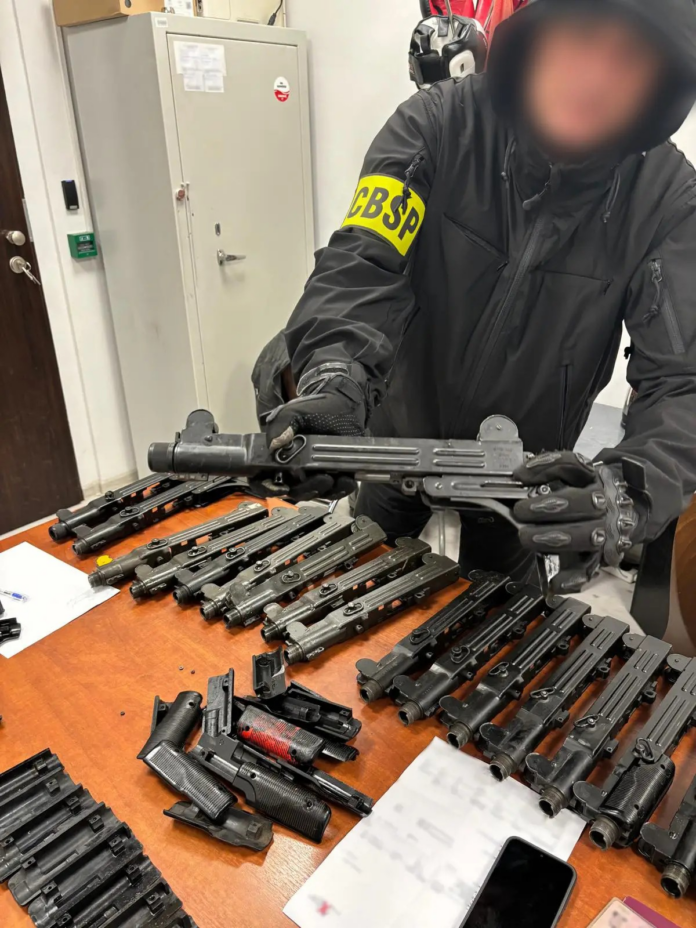
The defendant exported firearms and ammunition worth over $1.5 million from the United States to Russia, in violation of U.S. law.

When sentenced, Zharnovnikov faces up to 20 years in prison.

“The defendant admitted that he purchased American-made, military-grade firearms and re-exported them to Russia,” stated United States Attorney Nocella.  “Today’s guilty plea is the culmination of extensive investigative work, showing that this Office will not allow merchants of lethal weapons to flout U.S. sanctions.”

“Sergei Zharnovnikov admitted to violating export control laws by exporting US semi-automatic firearms to Russia via Kyrgyzstan.  Schemes designed to evade export laws are not only illegal but also endanger our country’s security. The FBI along with our partners will continue our efforts to defend the homeland by bringing to justice any criminal attempting to evade the laws enacted to protect our national security,” stated FBI Assistant Director in Charge Raia.

According to court filings and statements made during the plea proceeding, the defendant is the owner of an arms dealer located in Bishkek, Kyrgyzstan (Kyrgyzstan Company-1). Since at least March 2020, the defendant, together with others, has conspired to export firearms controlled by the United States Department of Commerce (DOC) from the United States to Russia.

The defendant exported $1,582,836.52 worth of U.S.-manufactured firearms and ammunition from the United States to Russia.

In one transaction, he entered into a five‑year, $900,000 contract with a company in the United States (U.S. Company‑1) to purchase and export U.S. Company-1 firearms to Kyrgyzstan.

DOC issued a license for U.S. Company-1 to export firearms to Kyrgyzstan Company-1, but the license prohibited the export or re-export of the firearms to Russia.  Nevertheless, the defendant exported and re-exported U.S. Company‑1 firearms to Russia (via Kyrgyzstan), including semi‑automatic hybrid rifle-pistols from U.S. Company-1.

According to an export filing, U.S. Company-1 exported semi-automatic rifles from John F. Kennedy International Airport to Kyrgyzstan Company-1 on or about July 10, 2022.

On or about November 14, 2022, the General Director of a Russian company that is a client of the defendant executed a tax form listing the same semi‑automatic rifle‑pistols that U.S. Company‑1 had exported to Kyrgyzstan Company‑1, the defendant’s company.  The defendant did not apply for, obtain, or possess a license to export or re-export the semi‑automatic pistol-rifles to Russia.